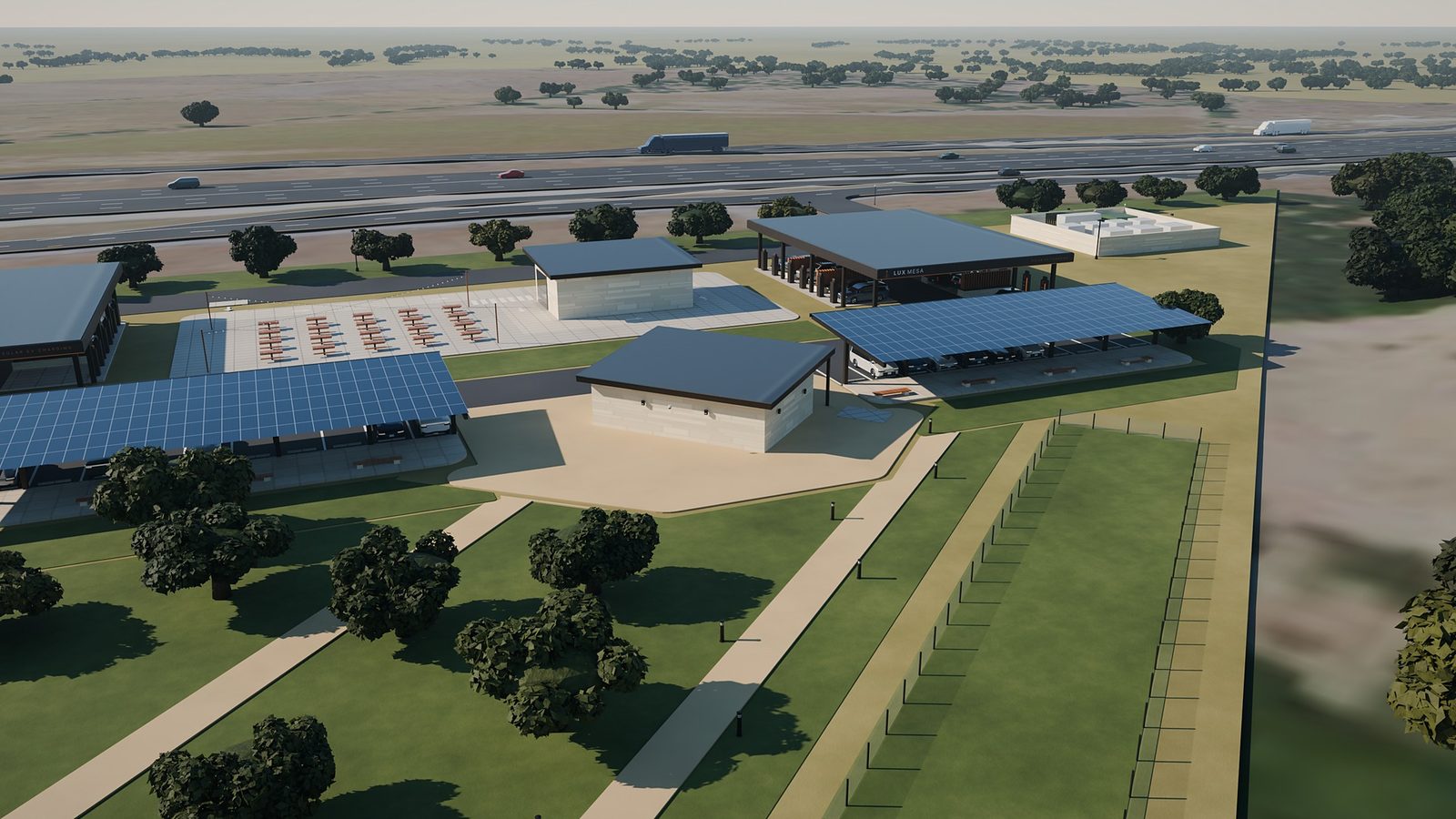
Concept aerial rendering of Lux Mesa Jarrell: charging canopies, solar carports, a coffee building with a patio, and a landscaped garden beside I-35

Lux Mesa · Jarrell, Texas

Charge under the Texas sun.

A solar-powered fast-charging stop on I-35, just north of Jarrell, built as a place you'll be glad you stopped: shade, a garden, clean private restrooms and good coffee.

PLANNED · LATE 2027 GET OPENING UPDATES
8 → 28DC fast-charging stalls, opening to full build-out
541 kWof solar on canopies and ground arrays
Up to 1 MWhof on-site battery storage
1.3 acresof garden with a walking loop
7.6 acresdesigned around the driver, not the pump

Powered by the panels overhead

More sun in every charge.

Lux Mesa Jarrell makes its own power. Solar panels on the charging canopies, the courtyard carports and two long ground rows feed the station directly, a battery smooths out the peaks, and the grid fills in the rest.

58%of the station's energy comes from on-site solar in its first full year, when the first eight chargers open.1
~860megawatt-hours of solar energy put to work every year once the array is fully used, about what 65 Texas homes use in a year.2
1 in 5kilowatt-hours still come from the sun when all 28 stalls are busy, and 26% over the first twenty years.1

Share of station energy supplied by on-site solar

Estimated, by year. The array stays the same size while charging grows from 8 to 28 stalls, so solar's share settles near 21%.

Show the numbers
YearStallsSolar used (MWh)Solar share

The carbon math

Cleaner than the grid. Far cleaner than the pump.

Every kilowatt-hour the panels supply is one the station doesn't buy from the Texas grid. Here's what that adds up to, compared with an identical station running on grid power alone.3

287METRIC TONS CO₂e A YEAR

avoided once the station is fully built out, versus the same 28-stall stop running entirely on grid power.

62CARS' WORTH, EVERY YEAR

That's the annual emissions of about 62 typical gasoline cars, cancelled out by the panels alone.4

5,100METRIC TONS CO₂e, 2027–2046

avoided over the station's first twenty years of operation, with no change in how drivers charge.

Annual CO₂ for the same ~13.7 million miles of driving

Gasoline cars (25 mpg)
4,880 t
EVs on a grid-only charger
1,380 t
EVs charging at Lux Mesa
1,090 t

At full build-out, drivers charging here cut tailpipe-equivalent emissions by about 78% (roughly 3,800 tonnes a year) compared with driving the same miles on gasoline, and solar takes another 21% off what a grid-only charger would emit.5

The stop

Designed for the twenty minutes you're here.

Most chargers are a plug at the back of a parking lot. Lux Mesa Jarrell is a shaded, landscaped stop where the wait is the good part of the drive.

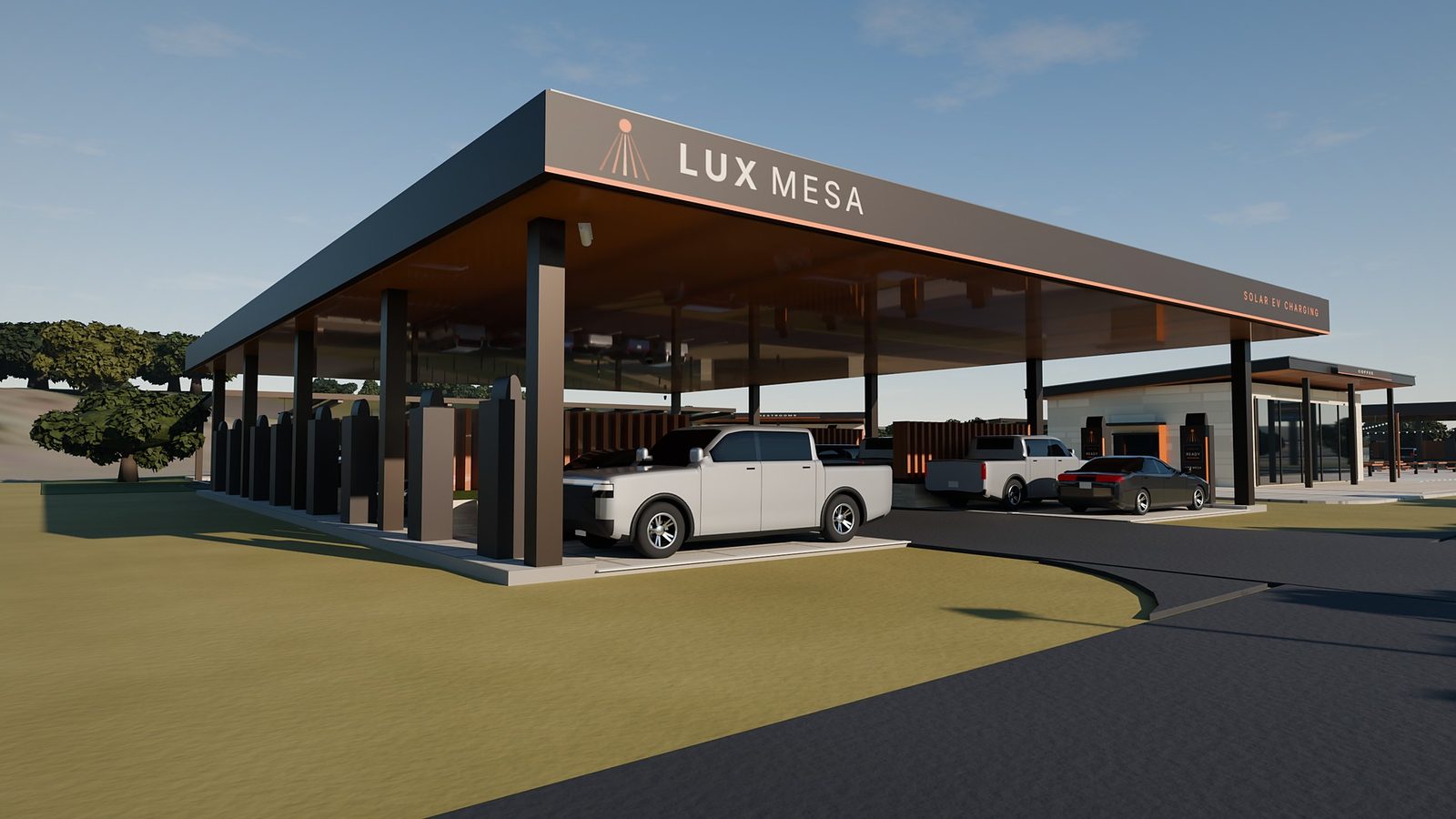
Concept rendering of the Lux Mesa charging canopy with cars at fast chargers

Fast, shaded charging

DC fast chargers under a solar canopy, built for any EV. Stalls are a generous 20 feet deep, so full-size pickups fit, and the station grows from 8 to 28 stalls as demand does.
Concept rendering of the restroom courtyard between the solar carports, with the garden and picnic pavilion beyond

Private restrooms

Individual, fully enclosed stalls with a shared wash area, unlocked by a code that comes with your charging session. Reached by a shaded walkway with benches under the solar carports.
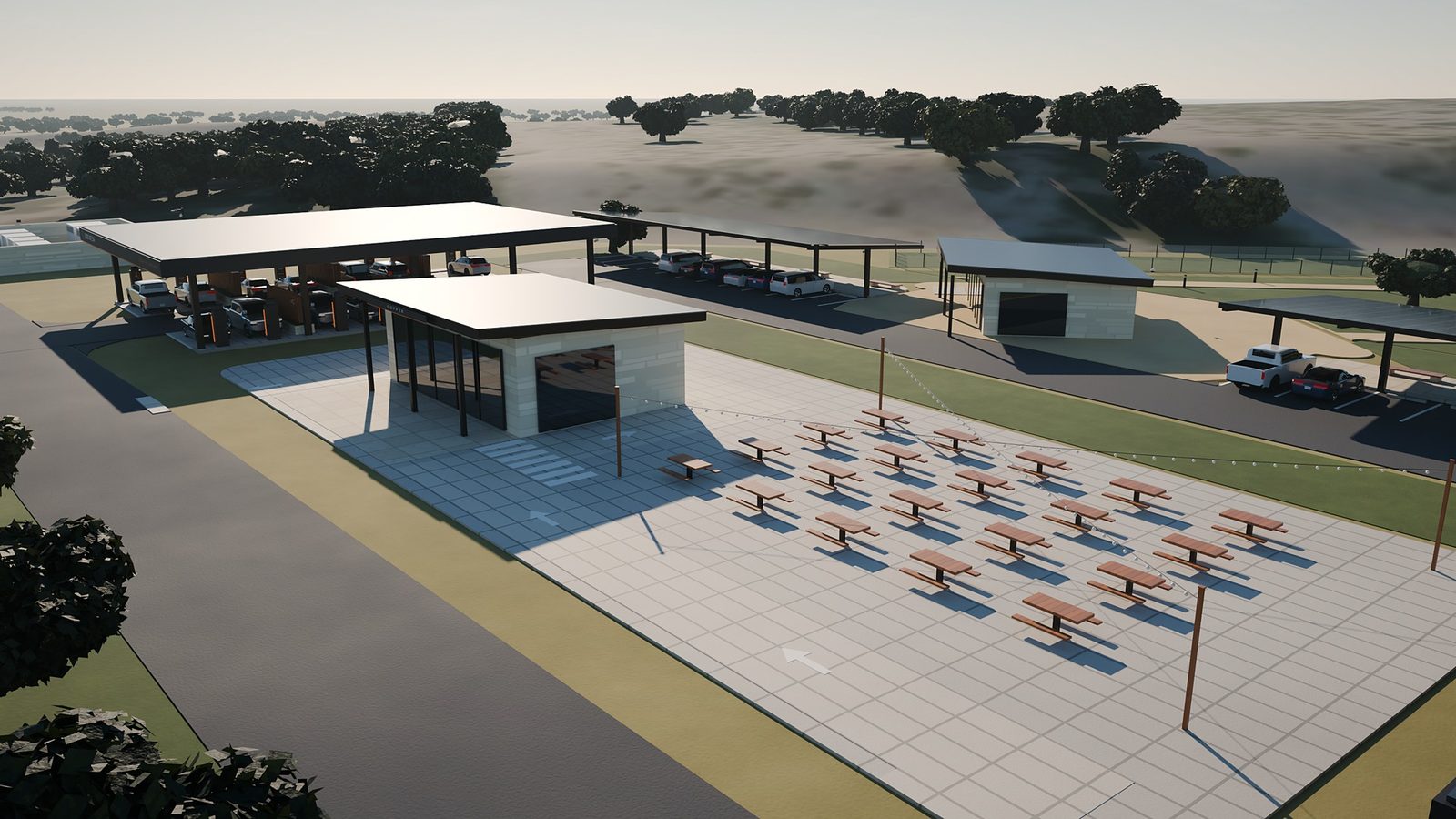
Concept rendering of the coffee building with a drive-thru and an outdoor patio with tables

Coffee and a patio

A coffee shop with a walk-up door, a drive-thru and a large outdoor patio opening onto the garden. Grab a drink while the car charges.6
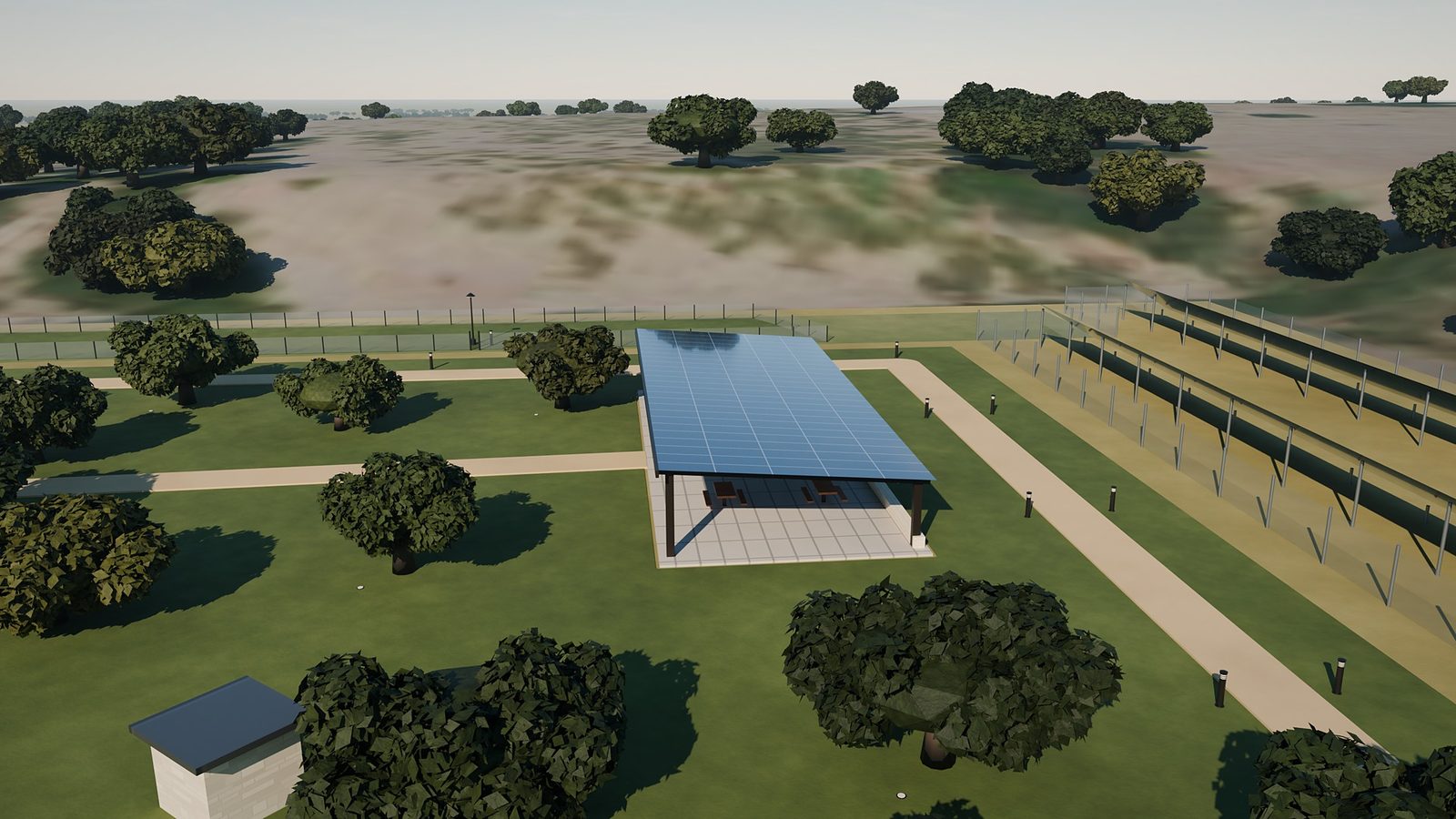
Concept rendering of the garden walking loop and picnic pavilion, with the solar array beyond

A garden to walk in

About 1.3 acres of landscaped garden with a walking loop, a shaded picnic pavilion and a fenced dog walk. Stretch your legs instead of staring at a screen.
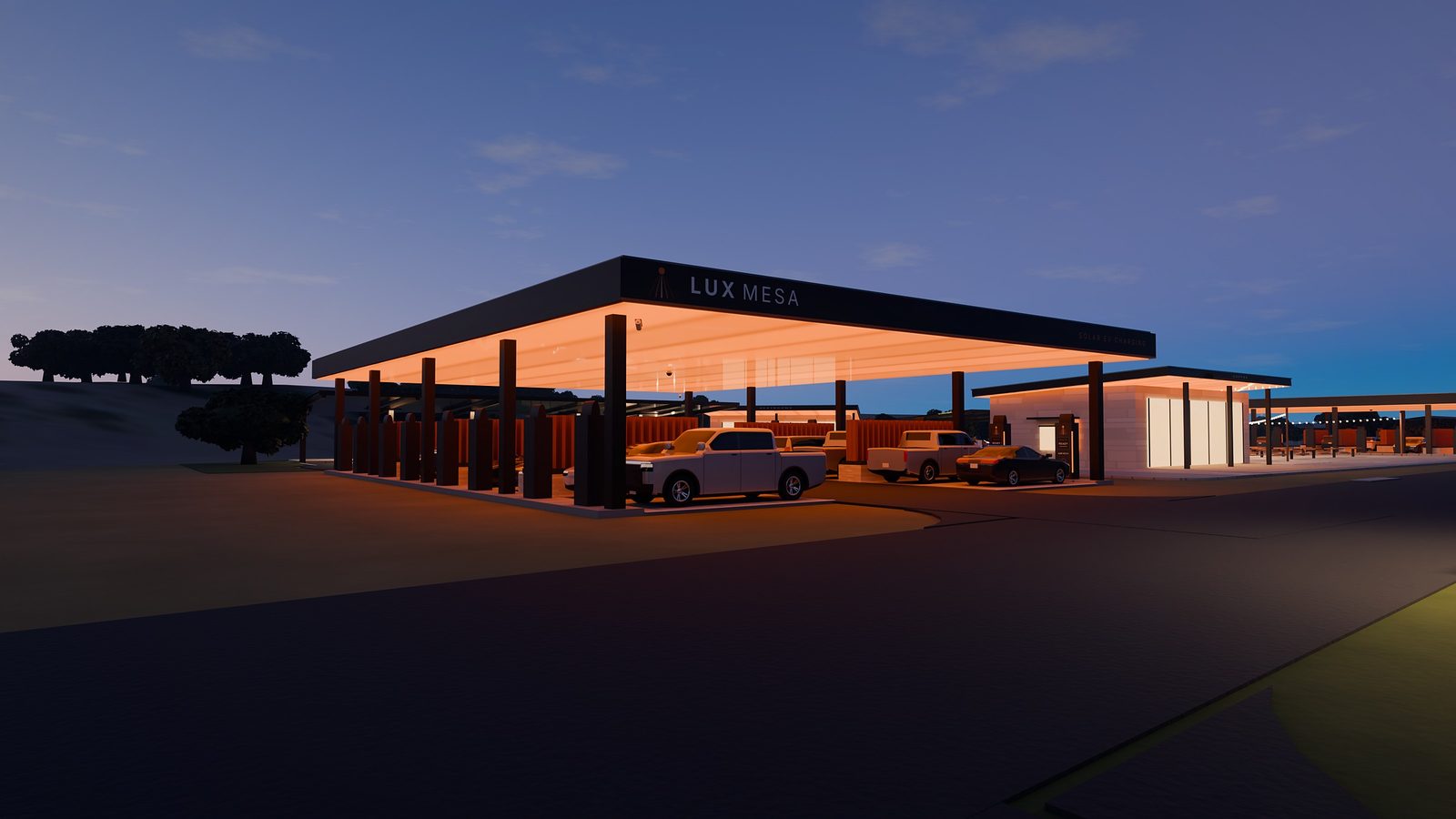
Concept rendering of the charging canopy lit at dusk

Bright, safe and open late

Warm, dark-sky lighting under the canopies and along the paths, and security cameras over the chargers, so evening stops feel as easy as midday ones.

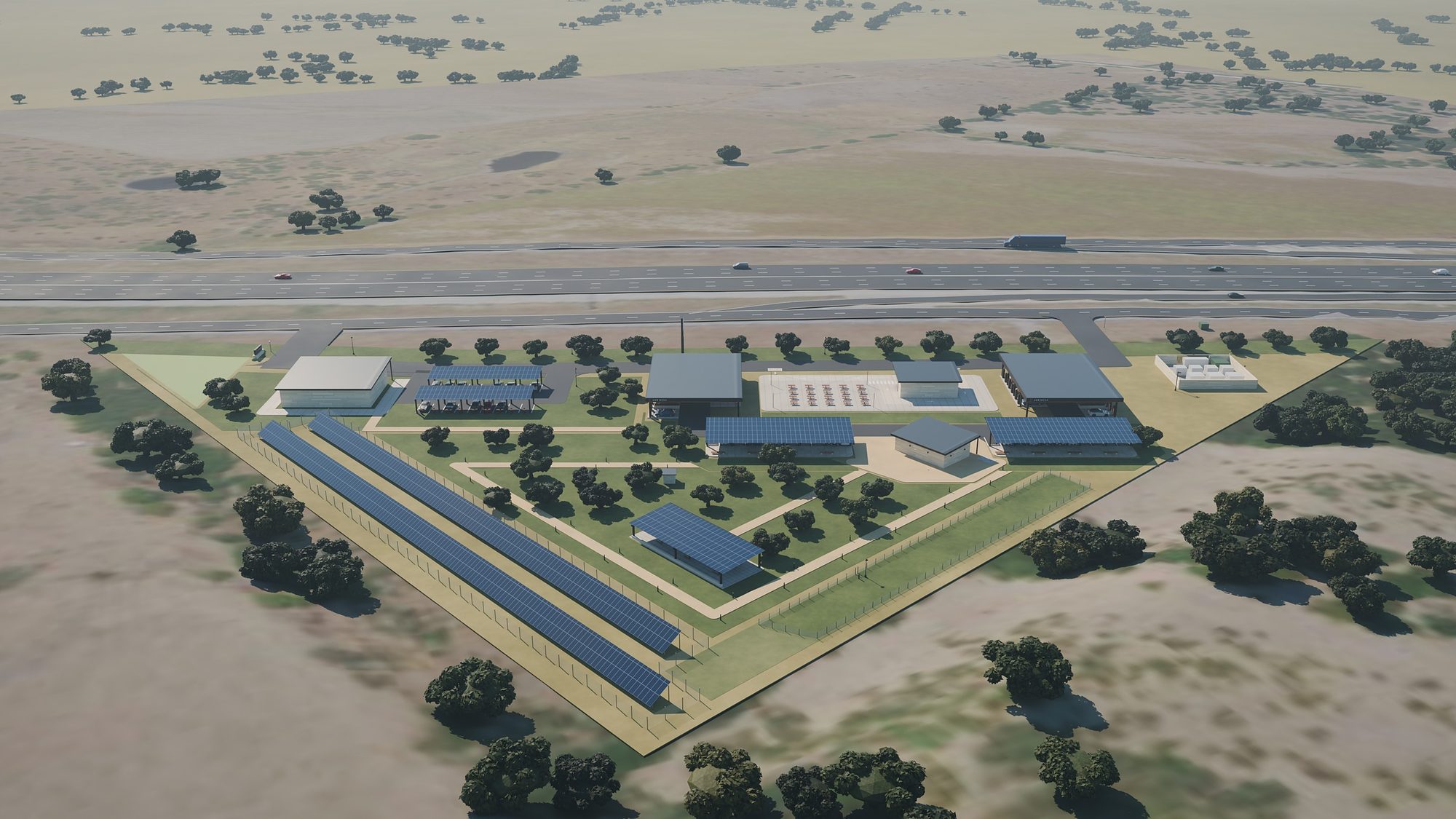
Concept aerial rendering of the full Lux Mesa Jarrell site

Room to move

Wide drive lanes, shaded parking for the coffee shop and courtyard, and space for a second shop on site. No squeezing past a line of cars to leave.

Location

I-35, just north of Jarrell.

On the northbound frontage road about 1.4 miles north of Jarrell in Bell County, between Austin and Temple.

  • An easy stop for northbound I-35 travelers, with a direct path back to the on-ramp
  • About 40 miles north of downtown Austin
  • Planned opening: late 2027

Be first to plug in.

Sign up for opening news, early-access charging and updates on Lux Mesa stops across Texas.

KEEP ME POSTED

How we calculated this

  1. Solar share = solar energy used on site ÷ total station energy, from Lux Mesa's hourly planning model for this site (541 kWdc array, 250 kWh battery growing to 1 MWh, 8 stalls in 2027 rising to 28 by 2037). Charging losses of about 5% are included. 2027 is a partial year (Q4 opening).
  2. About 860 MWh a year of grid purchases displaced at full build-out (4.12 → 3.27 GWh/yr). Home comparison uses roughly 13,500 kWh a year per Texas household (about 1,130 kWh a month, EIA).
  3. Grid emissions use the U.S. EPA eGRID2023 average for the ERCOT region, 736.6 lb CO₂e per MWh (EPA eGRID summary tables). Texas's grid is getting cleaner each year, so savings in later years will likely be somewhat smaller than shown; displacing peak-hour gas generation (EPA's non-baseload rate is about 1,248 lb/MWh) would make them larger.
  4. Uses EPA's figure of about 4.6 metric tons of CO₂ per typical passenger vehicle per year (EPA Greenhouse Gas Equivalencies).
  5. At full build-out the station is modeled to deliver about 3.9 GWh a year. At 3.5 miles per kWh that is about 13.7 million EV miles. The gasoline comparison assumes 25 mpg and 8.887 kg CO₂ per gallon (EPA). EV figures count only electricity emissions; none of the comparisons include vehicle manufacturing.
  6. Coffee and second retail tenants are planned and not yet signed. All renderings are conceptual, and figures are pre-construction estimates that will change with final engineering.